

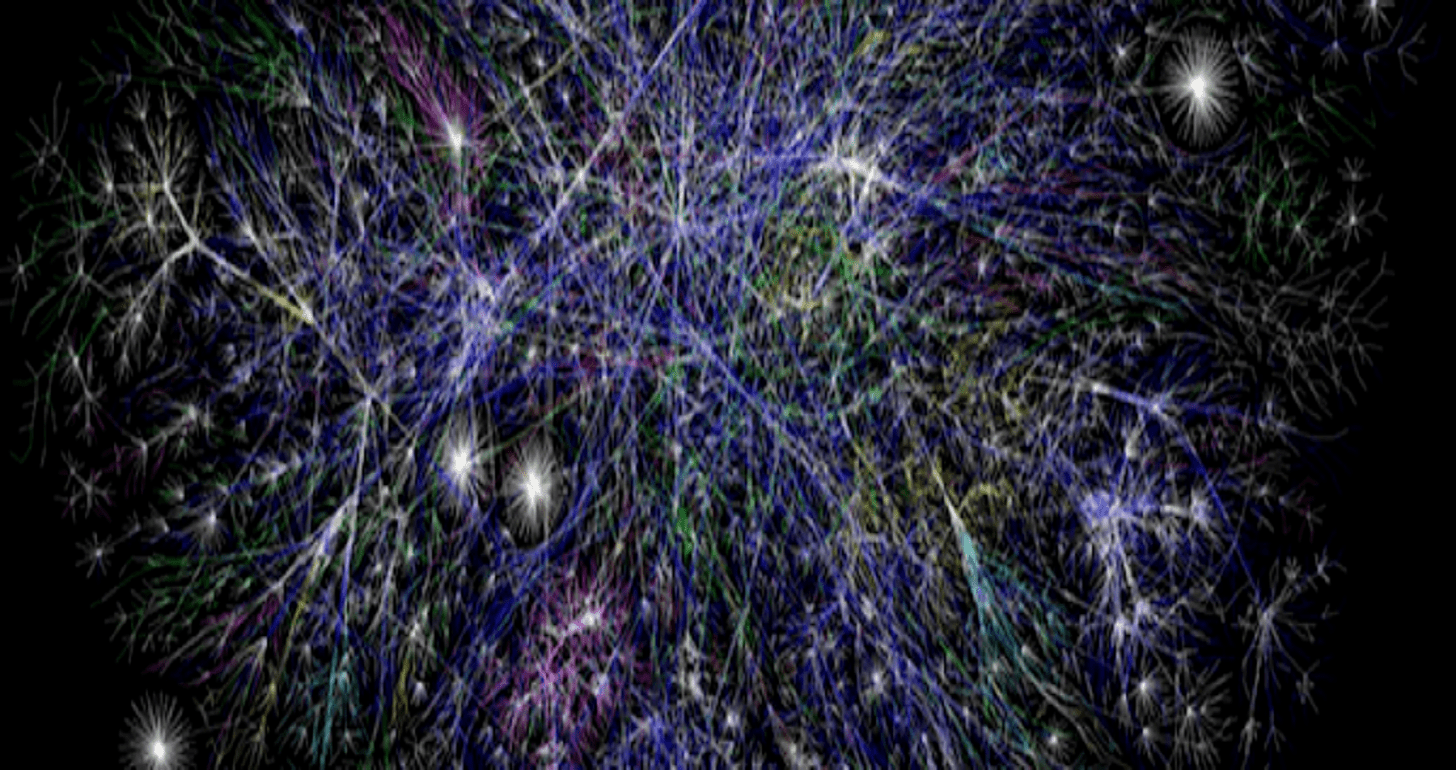
Network science, rooted in statistical physics and graph theory, has emerged in recent years to help us understand how complex networks like the internet form and evolve over time.
Networks like the Internet are built on a process called “Preferential Attachment”. “Preferential Attachment” is often referred to as the “rich get richer” phenomenon – that is, the more popular an element in a network (e.g., domain name, website, social influencer), the more new people joining the network link to it.
Over time, “Preferential Attachment” led to clustering between related websites, which led to the emergence of today’s search engines. Data-driven marketers saw these clusters as extremely competitive ecosystems. It can be argued that the reason Google succeeded where previous search engines failed was due to their thorough understanding of the link structure of scale-free networks.
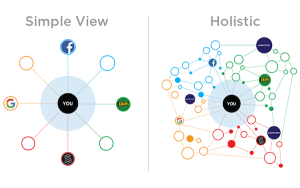
A comprehensive understanding of the marketing ecosystem offers countless benefits to marketers and will, in fact, change marketing indefinitely. This presents a significant opportunity for marketers to move away from last-touch models and other simplistic models. Marketers can now identify the factors (domains, websites, KOLs) that influence traffic and revenue – factors that come into play before customers ever reach their domains or their competitors.
Graph theory methods allow ingenious Marketers to not only accurately define their markets, but also track competitors, pinpoint where profits and losses occur, and predict where the biggest revenue opportunities can be captured.
When combined with artificial intelligence techniques like reinforcement learning, these methods help optimize strategies to allocate budgets and ultimately drive revenue.
Harness the power of the network: Viral value
While significant insights can be gained from a static view of network connectivity, these insights can become more predictive if we can understand how connectivity patterns in competing ecosystems will persist into the future.
Using advanced mathematical techniques (including Markov Chain theory and algebraic topology), it is possible to determine both the direct traffic of a particular web domain and its indirect traffic within the network that the Marketer or brand controls.
Good marketers will look to understand the direct traffic contribution of each source – as well as the indirect referral value of those same sources – to uncover the traffic sources that generate the most traffic and revenue.
Marketers have the ability to see the best direct and indirect sources to anticipate change, gain market share, and win traffic and revenue.
By prioritizing opportunities within the ecosystem that have a higher viral value to them and their competitors, Marketers will see a greater increase in traffic across multiple sites within their ecosystem than if they were driven solely by direct traffic or a “Last-click attribution model.”
Optimize budget allocation with AI.
The proliferation of marketing channels has led to a plethora of opportunities for media and marketing investment, along with an abundance of data. With the constant changes in preferences, trends, seasons, and other factors in the ecosystem, marketers cannot do without sophisticated AI tools to detect, predict, or respond to opportunities or threats in real time.
In Marketing, AI implementation has an impact with a single goal – real-time, highly actionable results.
While AI is portrayed in the media as a terrifyingly powerful technology, the reality is that there are many different machine learning algorithms, each suited for specific tasks.
In fact, the art of AI is not just about building algorithms themselves. Rather, it is the ability to define a problem in such a way that the algorithm can identify patterns and “learn” the best solution, based on the data and computational resources available.
Just like how self-driving cars have internal algorithms to identify lanes and other vehicles, temporal Internet models can form context to identify most marketing problems and optimize predictive outcomes across a range of possible marketing actions.
While marketers can certainly benefit from other types of artificial intelligence – such as those for natural language processing or image classification – the future of AI in marketing will focus on optimization methods like reinforcement learning from historical data as well as real-time performance.
Reinforcement learning (RL) is a modern artificial intelligence technique that can solve problems that cannot be solved using traditional optimization methods. RL can continuously self-adjust based on new information, making it ideal for optimizing network operations such as budget allocation and targeting specific goals.
Looking to the future
Marketers have a lot to look forward to from AI in the coming years. Graph theory and algebraic theory are not artificial intelligence. They are the foundation for building intelligent systems for online markets. The environment is a challenging target, and multiple competitors, trends, multiple scales, and patchy data sets make these problems especially difficult.
Over the next few years, we’ll likely see more similar systems. Over time, as scientists learn to build better models to understand markets, these systems will take over more of the work of marketers, freeing them up to focus on the more strategic and creative aspects of their work.
Original post: A brief introduction to network science math in marketing – Chief Marketing Technologist (chiefmartec.com)
Translator: Hoang Bach